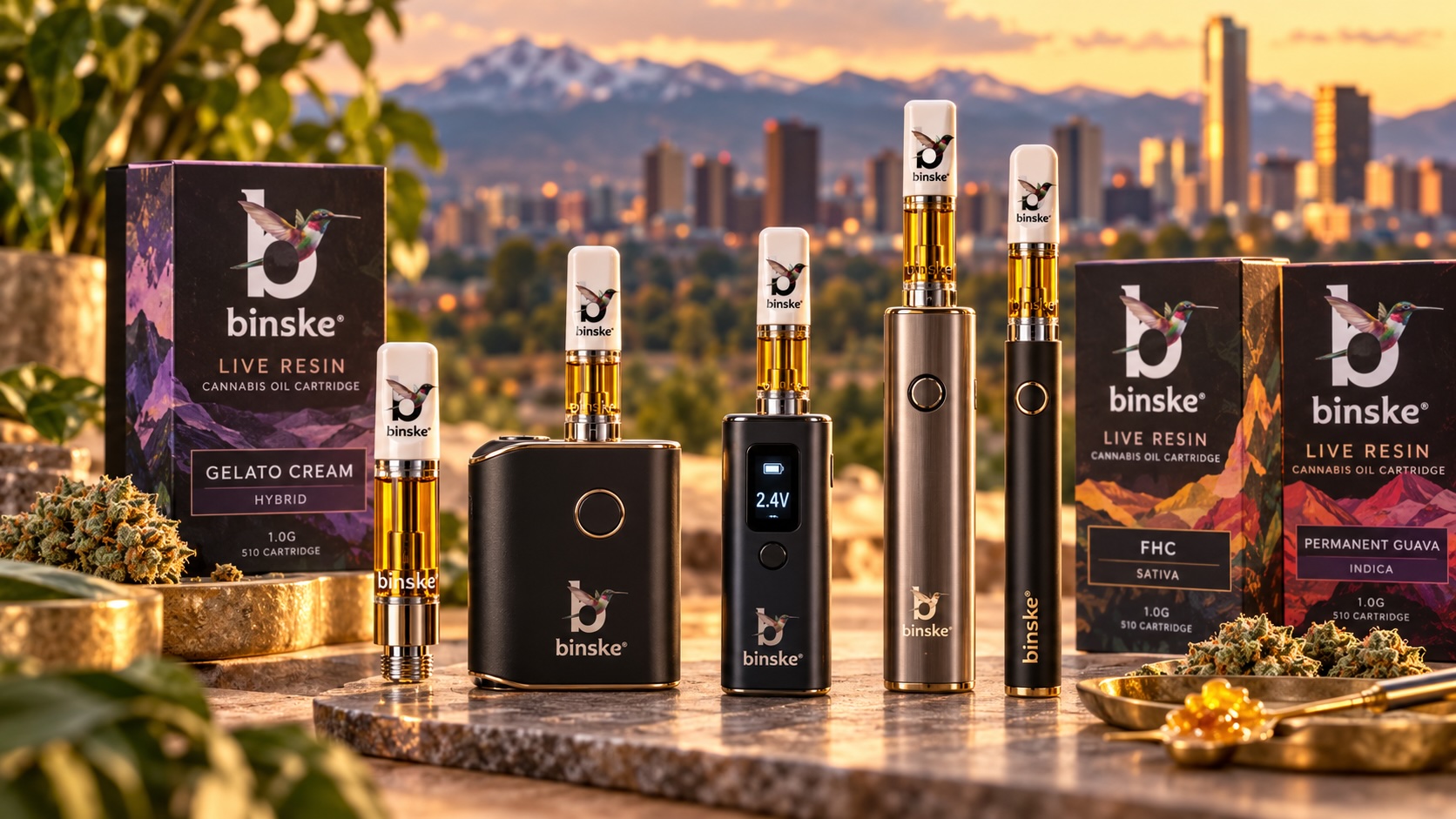
The best 510 battery for live resin is one that runs low, roughly 2.5 to 3.3 volts, and has a preheat for thick oil. Live rosin wants even less heat, so for rosin carts pick a battery that can go below 2.2 volts. Our top picks are the CCELL Palm Pro for most live resin users, the Yocan Kodo Pro for fine control on a budget, and the Zeus Ion Pro or Vessel Compass Rise for rosin.
binske does not make batteries and earns nothing from these picks. We make live resin carts, and the battery you screw them onto decides whether they taste like the strain or like burnt toast. That is reason enough to get this right.
Why live resin and rosin need a different battery
Many 510 batteries are tuned with distillate in mind, a refined oil with little native terpene content. Live resin and rosin carry far more terpenes, and that changes how much heat they can take.
They are terpene-rich. binske carts use HTE, the terpene-rich fraction of live resin. Terpenes are the first thing to burn off when a coil runs hot, so the more of them a cart carries, the lower the setting it wants.
Those terpenes are heat-sensitive. Push too much power through the coil and the lightest aromatics go first.
Terpene boiling points, and the number most charts get wrong
| Terpene | Boiling point | Common in |
|---|---|---|
| Alpha-pinene | 155 to 156°C | Pine, herbal strains |
| Myrcene | 166 to 167°C | Earthy, fruity strains |
| Limonene | 175 to 176°C | Citrus strains |
| Linalool | about 198°C | Floral strains |
| Beta-caryophyllene | 256 to 259°C | Pepper, spice, gas strains |
Boiling points from PubChem. Many cannabis terpene charts list beta-caryophyllene at about 119 to 130°C. That figure is measured under reduced pressure. At normal air pressure, PubChem lists beta-caryophyllene at 256 to 259°C, which makes it one of the more heat-tolerant terpenes, not one of the most fragile.
One caveat: terpenes start to evaporate well below their boiling points. Use the table to see which aromatics fade first, not as a battery setting.
Voltage is not temperature
Most 510 batteries let you choose voltage, not temperature. The heat you get depends on that voltage, the resistance of the cart’s coil and how much oil is on it. That is why the same setting can taste perfect on one cart and harsh on another. Batteries marketed with “heat settings” are almost always voltage presets under a friendlier name.
What voltage to use for each oil type
| Oil type | Starting range | Source |
|---|---|---|
| Distillate | 2.5 to 3.5V | CCELL general guidance |
| Live resin | 2.5 to 3.3V | CCELL live resin guidance |
| Live rosin | about 2.0 to 2.5V | Practitioner guidance; no hardware maker publishes a rosin figure |
Start at the bottom of the range and step up by 0.1 to 0.2 volts only if vapor is thin. Hardware makers do not publish a rosin-specific voltage, so treat the rosin range as a starting point and let taste decide.
The best 510 batteries for live resin and rosin, compared
Specs come from each maker’s product page. Prices are approximate US retail in 2026 and vary by seller.
| Battery | Capacity | Voltage settings | Lowest setting | Preheat | Approx. price |
|---|---|---|---|---|---|
| Zeus Ion Pro | Not listed by maker | 1.6 to 4.2V in 0.1V steps | 1.6V | 10s at 1.8V | $76 to $100 |
| Yocan Kodo Pro | 400mAh | 1.8 to 4.2V in 0.1V steps | 1.8V | 1.8V | $15 |
| Vessel Compass Rise | 550mAh | 1.9 / 2.4 / 2.8 / 3.2 / 3.6V | 1.9V | Yes, 8s | $69 |
| Kind Pen Twist | 400mAh | 2.0 to 4.0V twist dial | 2.0V | 1.8 to 2.0V | $25 |
| CCELL Fino | 190mAh plus 1000mAh dock | 2.2 to 3.6V in 0.2V steps | 2.2V | 10s | $49 |
| CCELL Palm Pro | 500mAh | 2.8 / 3.2 / 3.6V | 2.8V | 10s | $22 |
| CCELL Rizo | 300mAh | 2.8 / 3.3V | 2.8V | Not listed | $20 |
| CCELL M3 Plus | 350mAh | 2.8 / 3.3V | 2.8V | Not listed | $15 |
| CCELL Sandwave | 400mAh | 2.8 / 3.2 / 3.6V | 2.8V | Not listed | $13 |
Best overall for live resin: CCELL Palm Pro
The Palm Pro’s lowest setting, 2.8 volts, sits in the middle of CCELL’s live resin range. It adds a 10-second preheat, an adjustable airflow collar and a magnetic drop-in connection, all for about $22. For most people running live resin carts, it is the easiest battery to recommend.
Best for live rosin: Zeus Ion Pro
The Ion Pro goes as low as 1.6 volts in 0.1-volt steps, and its smart voltage curve adjusts power during the draw so heat stays steadier as the coil warms. That is the closest thing on this list to real temperature management. It is also the most expensive battery here, so it makes sense if rosin carts are your regular habit.
Best fine control on a budget: Yocan Kodo Pro
At about $15, the Kodo Pro covers 1.8 to 4.2 volts in 0.1-volt steps with a small screen showing your exact setting. No other battery here gives you that much control for the money.
Best premium build: Vessel Compass Rise
The Compass Rise is all metal, remembers your last setting and starts at 1.9 volts, low enough for rosin. You pay for the build quality, at about $69.
Best simple dial: Kind Pen Twist
The Twist uses a dial from 2.0 to 4.0 volts, so you can make small adjustments without counting button clicks. It also carries a lifetime warranty.
Best for carrying all day: CCELL Fino
The Fino pairs a small battery with a charging dock that doubles as a power bank. Its eight settings run from 2.2 to 3.6 volts.
Best budget batteries: CCELL Sandwave, M3 Plus and Rizo
All three bottom out at 2.8 volts, which suits live resin but runs hot for rosin. The Sandwave is the cheapest, at about $13. The Rizo adds haptic feedback. The M3 Plus is a slim pen with no button.
How to dial in a new live resin cart
- Let a new cart sit upright for a few minutes so the oil can soak into the ceramic coil.
- Start at your lowest setting. Take one short, slow pull of two to three seconds.
- Use preheat when the oil is cold. Oil moves slowly on a cold day. Preheat loosens it without burning it.
- Step up slowly. Raise voltage by 0.1 to 0.2 volts only if vapor is thin.
- Wait between pulls. Chain-pulling dries the coil faster than oil can refill it.
Why your live resin cart tastes burnt
CCELL and other hardware makers point to the same few causes:
- Too much voltage. The most common cause, and the easiest fix.
- A dry coil. Pulling with no oil on the coil can burn it and permanently ruin the flavor, according to CCELL’s guide to clogged carts.
- Chain-pulling. Oil needs a few seconds to re-soak the coil.
- Cold oil. Chilled live resin thickens and starves the coil.
- An almost empty cart. The last bit of oil cannot reach the coil evenly.
When you do not need a separate battery at all
If the voltage talk sounds like too much work, skip the battery. The binske Live Resin All-In-One puts the battery, ceramic heating element and 1g of live resin in one housing.
binske pairs its live resin with ceramic, wick-free hardware in a sealed device, so you are not guessing at voltage. It is draw-activated, rechargeable over USB-C and wick-free, which helps prevent the clogging and burnt pulls that drive most battery searches in the first place.
For more on choosing between formats, see our guide to the best disposable vapes and all-in-ones in Denver.
Where to find binske carts and all-in-ones
binske live resin carts fit every battery on this list. Use the binske store locator to find a dispensary near you. Colorado shoppers can start with our guide to the best live resin carts in Colorado.
Frequently asked questions
Can you use any 510 battery with any cartridge?
Almost always. The 510 thread is an industry standard, so any 510 cart screws onto any 510 battery. The only catch is size: some palm-style batteries fit only standard-width carts.
What voltage should I use for live resin?
Start at your battery’s lowest setting, ideally 2.5 to 2.8 volts. CCELL recommends 2.5 to 3.3 volts for live resin carts. Higher settings make bigger clouds but burn off terpenes.
What voltage should I use for live rosin carts?
Start lower, around 2.0 to 2.5 volts. No hardware maker publishes a rosin-specific figure, so begin at your battery’s lowest setting and adjust by taste.
What does preheat do on a 510 battery?
Preheat runs the battery at low power for about 10 to 15 seconds to warm thick oil before you pull. It helps live resin and rosin flow without scorching.
Does higher voltage get you higher?
Slightly, but at a cost. Higher voltage makes more vapor per pull, and it also burns terpenes and wastes oil. A lower setting with a slightly longer pull usually tastes better and lasts longer.